
MSCI World o MSCI World Equal Weight
Cómo decido dónde invierto mi dinero cuando no tengo una idea mejor

Mi cartera está construida para ser una especie de All-Weather simplificada: bonos, oro, emergentes, REITs, una parte de acciones de calidad, otra de acciones de mayor incertidumbre o crecimiento, y ocasionalmente commodities.
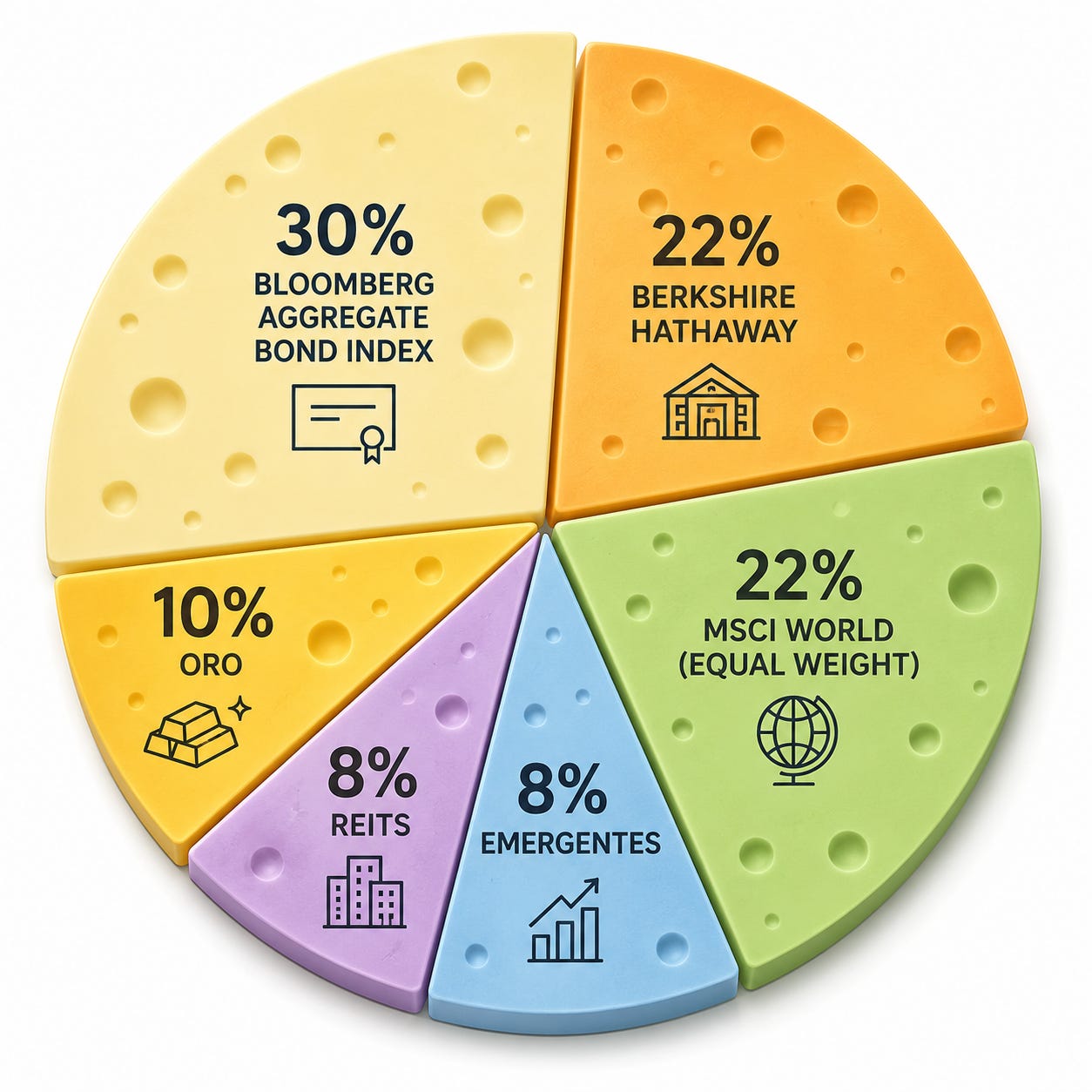
Ya he hablado de cómo gestiono la parte de emergentes en posts anteriores (con una posición base en MSCI Emerging Markets que puede rotar temporalmente hacia otros ETFs más temáticos, por ejemplo tecnología china), o mi estrategia de rotación de oro (que es la posición base) a plata según el ratio oro/plata. También hablé en artículos anteriores como gestiono la parte de bonos para que sea lo más simple posible.
Dedicaré más adelante un post entero al diseño completo de la cartera —pesos, rebalanceo, riesgo asumido—, pero hoy quiero centrarme en una pieza concreta: qué hago con el dinero cuando no tengo una idea “satélite” en la parte de acciones no-calidad.
Porque ese dinero no se queda parado. Va a su posición base. Y esa posición base no es fija: alterno entre MSCI World y MSCI World Equal Weight según una regla de valoración relativa.
En la parte de calidad esto es más sencillo: mi base es Berkshire Hathaway, y si encuentro una posición satélite en la que quiero invertir (como me pasó con McDonald’s recientemente), vendo parte de Berkshire para financiar la compra. Pero en la parte de bolsa “core-satélite” sin calidad definida, en su situación base (lo que no está invertido en satélites), la pregunta es “¿cuál de estos dos índices, que contienen básicamente las mismas empresas, tiene más sentido comprar ahora mismo?”
Dos índices, mismas empresas, dos filosofías
El MSCI World pondera por capitalización bursátil: cuanto más grande es una empresa, más pesa en el índice. Si Apple vale más que Coca-Cola, Apple pesa más. Si Microsoft sigue subiendo, Microsoft sigue ganando peso. El resultado es un índice muy eficiente, pero cada vez más concentrado: hoy un puñado de compañías explica una parte desproporcionada de su comportamiento.
El Equal Weight hace justo lo contrario. Todas las empresas parten del mismo peso, da igual que sea Apple o una aseguradora europea mediana. No hay “líderes” dentro del índice por definición.
Es el mismo universo de empresas, mirado desde dos ángulos opuestos.
¿Cuál es mejor? Depende, y esa es la respuesta correcta
Hay periodos largos donde el MSCI World bate claramente al Equal Weight —normalmente cuando el mercado está liderado por un grupo reducido de mega caps—. Y hay otros donde ocurre lo contrario, cuando el liderazgo se amplía y empiezan a subir cientos de compañías a la vez en lugar de veinte.
El problema es que nadie sabe de antemano cuándo cambia ese liderazgo. Yo tampoco. Así que dejé de intentar adivinarlo y empecé simplemente a mirar el precio relativo entre ambos.
La lógica de fondo es sencilla: si dos supermercados venden prácticamente lo mismo pero uno cuesta sistemáticamente un 20% más, no tiene mucho sentido comprar siempre en el caro. Con estos dos índices pasa algo parecido: si contienen casi las mismas empresas pero uno cotiza de forma persistente más caro que el otro, puede tener sentido inclinar la balanza hacia el más barato. No porque vaya a subir mañana, sino porque, estadísticamente, pagar menos por beneficios futuros similares suele salir a cuenta con el tiempo.
De ahí nace el sistema.
La variable central
Todo gira en torno a un único ratio:
PER World / PER Equal Weight
Intento llevar un registro del Forward P/E y el Trailing P/E que publica MSCI para ambos índices.
https://www.msci.com/indexes/index/990100/msci-world-index
https://www.msci.com/indexes/index/129857/msci-world-equal-weighted-index
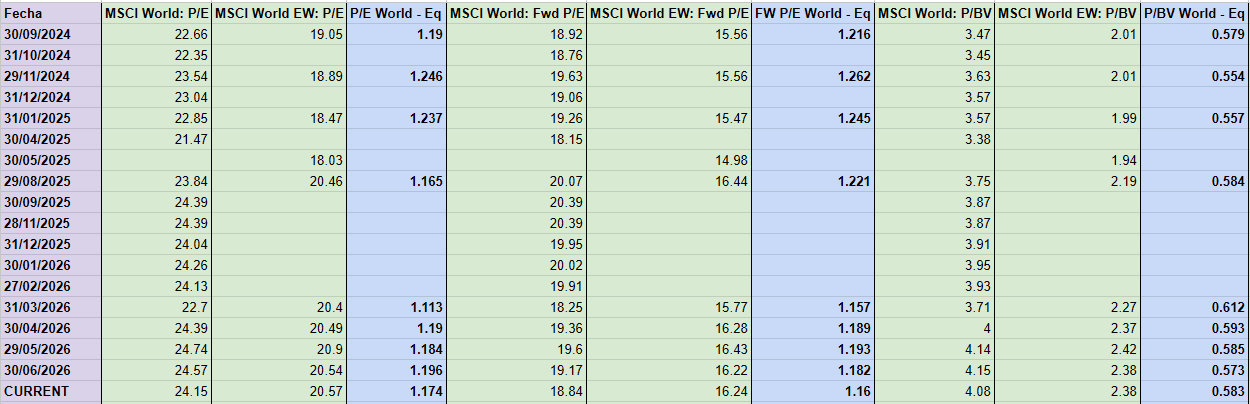
Sin mezclar proveedores ni metodologías distintas. La consistencia de la fuente importa más que perseguir el “PER perfecto”: si ambos índices se calculan exactamente igual, el ratio entre ellos sí es comparable.
Cuando VAL sube, el MSCI World se está encareciendo frente al Equal Weight. Cuando baja, la diferencia se estrecha. El sistema no intenta decidir si el mercado en su conjunto está caro o barato —eso es una pregunta distinta y mucho más difícil de responder—. Solo intenta contestar algo más acotado: de estos dos índices, ¿cuál ofrece hoy la valoración relativa más atractiva? Es una estrategia de valoración relativa, no absoluta.
Cómo se calcula y cuándo desconfío de la señal
VAL_fwd = PER_World_fwd / PER_EqualWeight_fwd
VAL_trl = PER_World_trl / PER_EqualWeight_trl
VAL = 0.6 × VAL_fwd + 0.4 × VAL_trl
Doy más peso al forward porque recoge mejor las expectativas de beneficios, pero incluyo el trailing como ancla frente a estimaciones demasiado optimistas o demasiado pesimistas.
Si la diferencia entre VAL_fwd y VAL_trl supera el 10-15%, no opero. Cuando ambas métricas discrepan tanto, suele ser señal de que el mercado está descontando algo poco fiable —una revisión de beneficios en marcha, ruido puntual— y prefiero esperar a que la imagen se aclare antes de mover capital.
Las reglas de decisión
VAL < 1,10 → Rotación y nuevas aportaciones a MSCI World, a través del ETF IWDA, que es mi posición por defecto.
1,10 ≤ VAL ≤ 1,25 → Zona neutra. No rotación de capital ya invertido. Aportaciones nuevas exclusivamente a MSCI World.
VAL > 1,25 y tendencia de VAL ascendente → El Equal Weight cotiza con un descuento relevante. Aquí considero rotar toda la posición hacia MWEQ (ETF que sigue al Equal Weight), siempre que el filtro de momentum lo confirme (ver abajo).
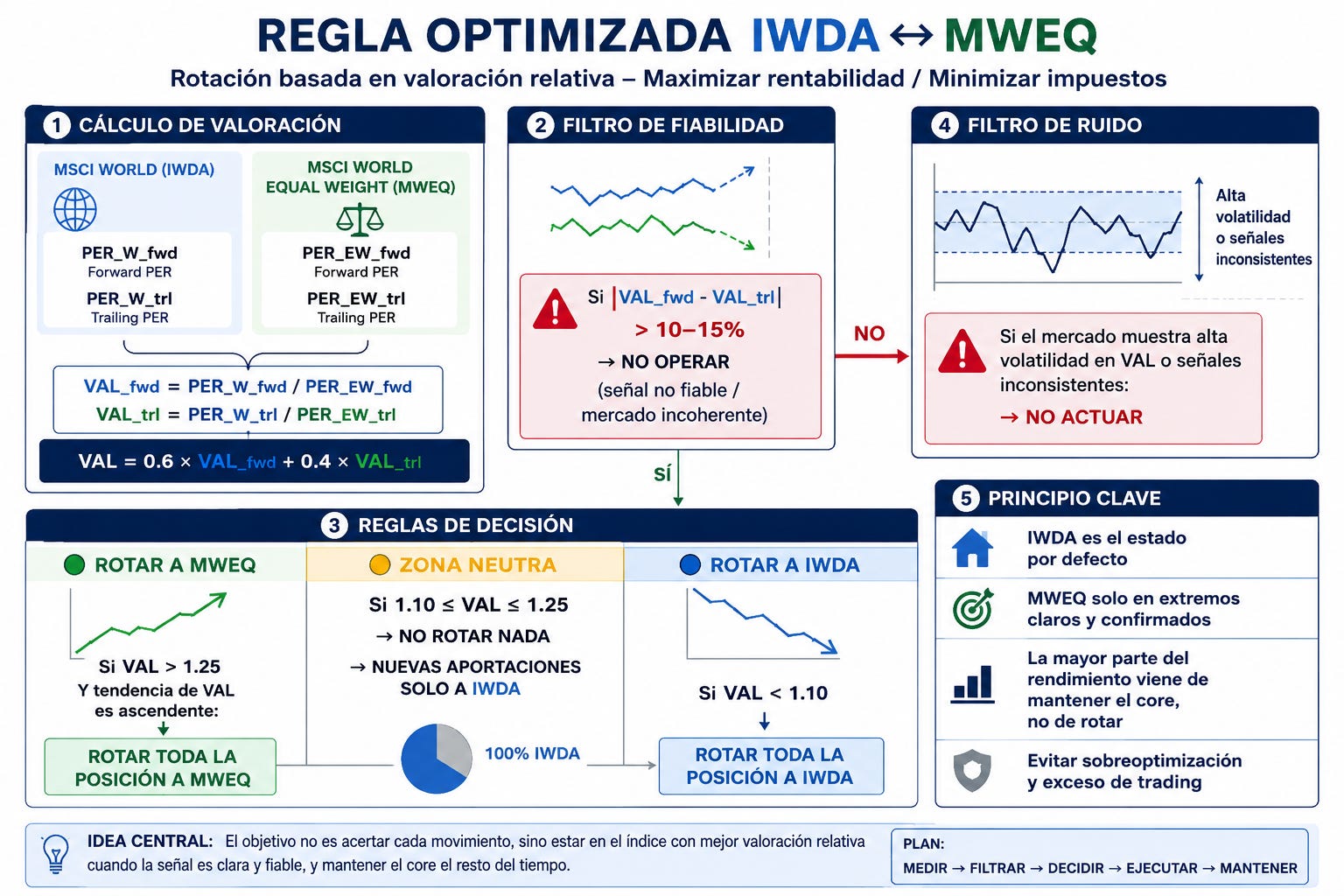
MSCI World es el estado por defecto del sistema. Equal Weight solo entra en juego en extremos claros y confirmados. La mayor parte de la rentabilidad viene de mantener el core, no de rotar constantemente entre uno y otro.
Por qué la valoración sola no basta: el filtro de momentum
Todos conocemos activos que llevan años “baratos” y que simplemente siguen cayendo. Comprar solo porque algo parece barato es la receta clásica de la trampa de valor.
Por eso añado un segundo filtro, el momentum: calculo el cociente Precio MWEQ / Precio IWDA. Cuando ese cociente empieza a subir de forma sostenida, es señal de que el Equal Weight está empezando a comportarse mejor en términos relativos, y de que el mercado está reconociendo esa diferencia de valoración.
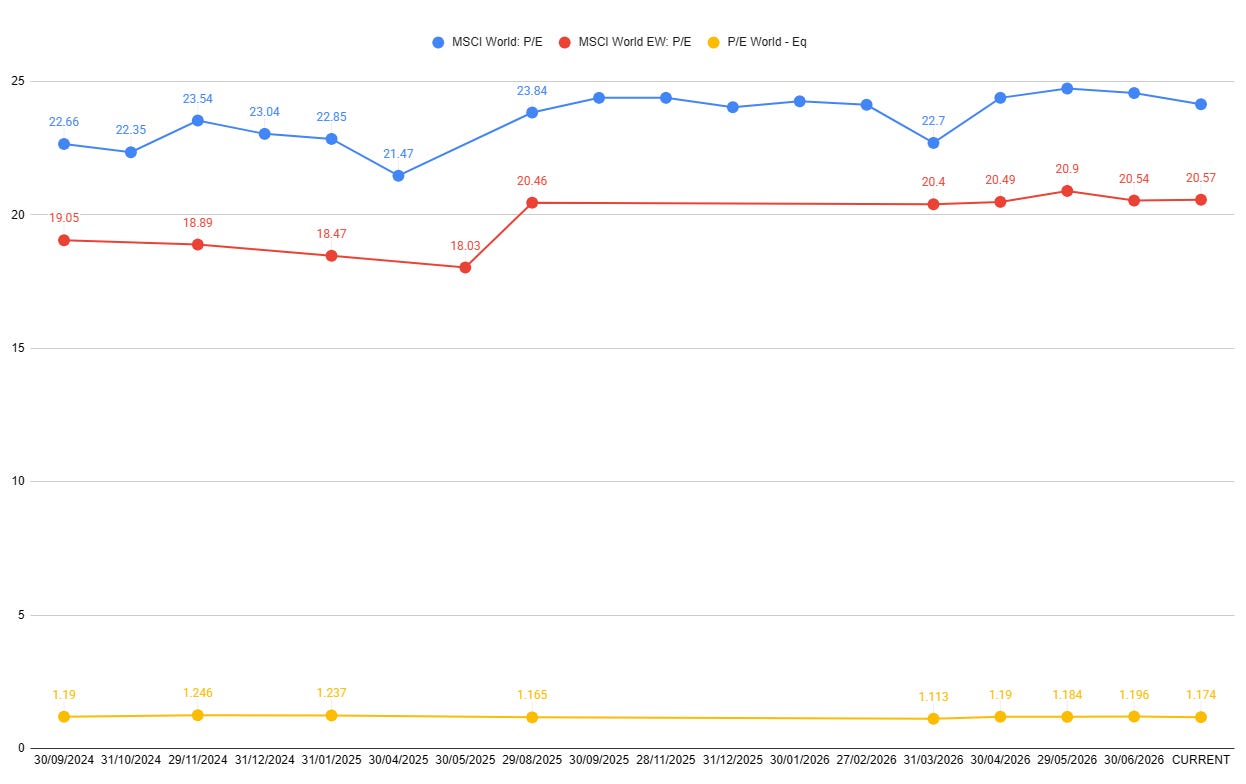
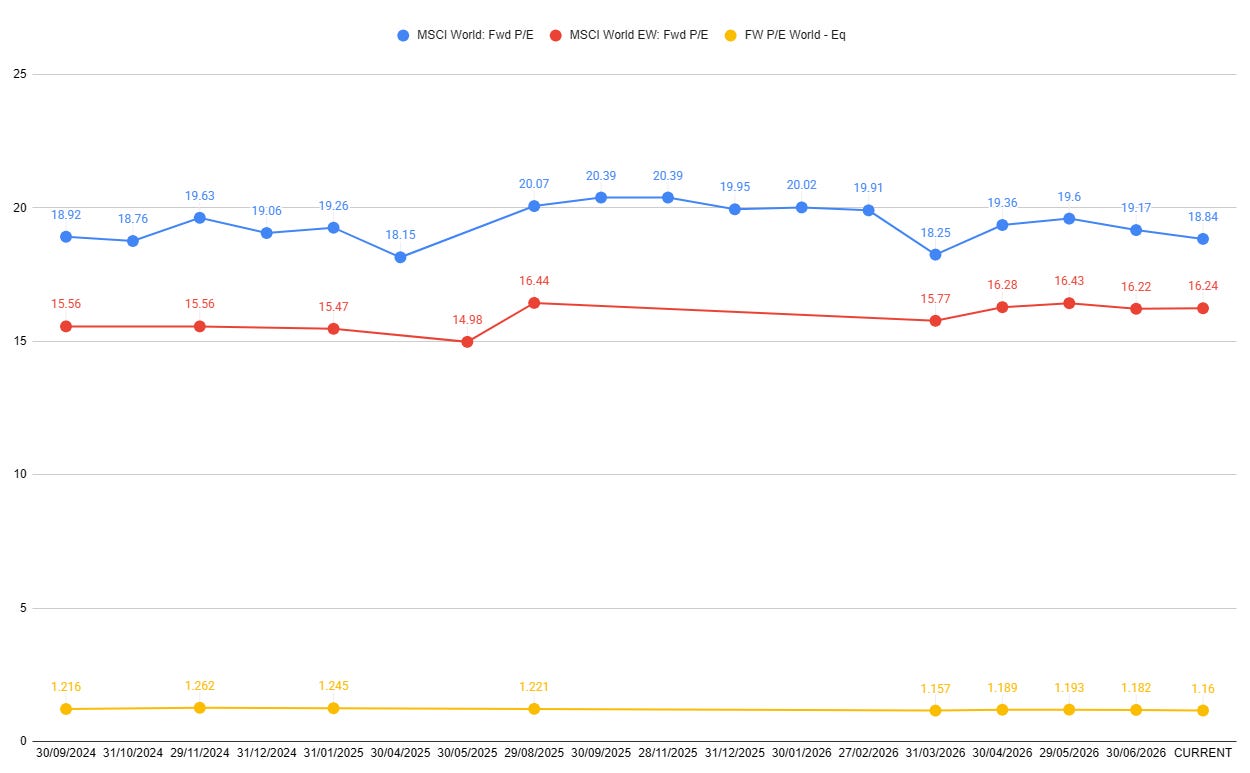
P/E MSCI World vs MSCI World Eq:
Forward P/E MSCI World vs MSCI World Eq:
No quiero comprar lo barato. Quiero comprar lo barato cuando empieza a dejar de caer.
Sobre las ventas: la paciencia también es parte del sistema
Las rotaciones completas generan impuestos, y ese es un coste que cuesta mucho recuperar. Por eso, mientras siga haciendo aportaciones periódicas, simplemente dirijo el dinero nuevo hacia el índice que ofrece mejor valoración relativa en ese momento, sin tocar lo ya invertido.
Reservo las rotaciones completas —vender todo un índice para pasar al otro— para situaciones excepcionales, cuando se cumplen dos condiciones a la vez: la diferencia de valoración es extrema, y el momentum confirma que el liderazgo de mercado realmente está cambiando. Si solo se cumple una, no hago nada. Esperar también es una decisión.
¿Por qué MSCI World Equal Weight? Una lección de la burbuja dot-com
Si miramos la burbuja de 2000-2001, donde también existía una concentración extrema en el índice ponderado por capitalización, vemos con claridad qué suele ocurrir cuando cambia el ciclo o rota el liderazgo del mercado.
Cuando las grandes tecnológicas —donde se había acumulado toda la concentración— empezaron a fallar, el índice ponderado se desplomó con fuerza. Pero el resto de valores, que habían quedado muy rezagados durante la fase alcista previa, aguantaron considerablemente mejor: no siguieron la caída de inmediato, sino con un desfase temporal notable. El Equal Weight terminó cayendo mucho menos y tardó bastante más en marcar techo que el índice tradicional.
La conclusión para una estrategia de rotación es clara: cuando se inicia un declive en las megacaps que arrastra a los índices ponderados, el índice de igual ponderación tiende a descorrelacionarse temporalmente de esa caída.
Es cierto que el MSCI World, al ponderar a favor de las empresas más grandes, suele ser más eficiente en condiciones normales de mercado. Pero en episodios de burbuja, cuando la concentración alcanza niveles extremos, puede tener sentido repartir la inversión por igual entre todas las empresas del índice hasta que la divergencia entre MSCI World y MSCI World Equal Weight se cierre. Esa es, precisamente, la razón de fondo de mi sistema de rotación entre ambos: la concentración extrema es un fenómeno que tiende a corregirse tarde o temprano, mediante un proceso de reequilibrio que puede ser lento, pero que históricamente ha llegado.
Y conviene recordar que esta dinámica no es exclusiva de Estados Unidos. El caso de MSCI Emerging Markets es hoy, si cabe, más extremo: el índice está fuertemente distorsionado por solo tres valores —TSMC, Samsung y SK Hynix—, que concentran una parte muy significativa del total y que podrían estar reflejando una burbuja propia en semiconductores.
Lo que este sistema no pretende hacer
No pretende predecir el mercado, ni batir todos los años al MSCI World, ni encontrar el momento perfecto de entrada. Puede pasar largos periodos rindiendo peor que simplemente quedarse quieto, y eso es perfectamente normal dentro de su diseño. Su objetivo es mucho más modesto: comprar el mismo conjunto de empresas intentando pagar, en cada momento, un precio relativamente más razonable por ellas. Nada más, nada menos.
Un proceso, no una opinión
Con el tiempo he entendido que la mayor ventaja de tener un sistema no es ganar unas décimas más de rentabilidad. Es eliminar la parte emocional de la decisión. Cuando el mercado cae, no tengo que preguntarme qué hacer. Cuando las tecnológicas se disparan, tampoco. Consulto la regla: si valoración y momentum apuntan en la misma dirección, actúo; si no, espero.
La disciplina, casi siempre, rinde más que la brillantez.
Conclusión
No creo que el MSCI World sea mejor que el Equal Weight, ni al revés. Son dos formas distintas de mirar el mismo universo de empresas, y el mercado atraviesa ciclos que premian primero a uno y después al otro. Mi trabajo no es adivinar cuál será el próximo ciclo. Es tener un proceso objetivo que me permita adaptarme cuando ese cambio empiece a producirse.
Al final, invertir rara vez consiste en encontrar el activo perfecto. Casi siempre consiste, simplemente, en tomar decisiones razonables de forma consistente durante muchos años.
Esto no es un consejo de inversión, cada uno debe estudiar y diseñar su propia cartera y sus estrategias. Si os ha gustado este artículo, suscribiros para recibir futuros posts.
Un saludo a todos.
English Version
MSCI World or MSCI World Equal Weight.
How I Decide Where the Money Goes When I Don't Have a Better Idea.
My portfolio is built as a simplified All-Weather approach: bonds, gold, emerging markets, REITs, a quality equity sleeve, another sleeve for higher-conviction or growth names, and occasionally commodities.
I’ve already covered how I manage the emerging markets sleeve in previous posts — a base position in MSCI Emerging Markets that can rotate temporarily into more thematic ETFs, such as Chinese tech — as well as my gold-to-silver rotation strategy based on the gold/silver ratio (gold being the base position). I’ve also written about how I keep the bonds sleeve as simple as possible.
I’ll dedicate a full post later to the complete portfolio design — weights, rebalancing, risk taken — but today I want to focus on one specific piece: what I do with the money when I don’t have a “satellite” idea within the non-quality equity sleeve.
Because that money doesn’t just sit idle. It goes to its base position. And that base position isn’t fixed: I alternate between MSCI World and MSCI World Equal Weight according to a relative valuation rule.
On the quality side, this is simpler: my base is Berkshire Hathaway, and if I find a satellite position I want to invest in (as happened recently with McDonald’s), I sell part of Berkshire to fund the purchase. But in the “core-satellite” equity sleeve without a defined quality tilt, in its base state (whatever isn’t invested in satellites), the question becomes: “which of these two indices, which contain essentially the same companies, makes more sense to buy right now?”
Two indices, same companies, two philosophies
MSCI World weights by market capitalization: the bigger a company, the more it weighs in the index. If Apple is worth more than Coca-Cola, Apple carries more weight. If Microsoft keeps rising, Microsoft keeps gaining weight. The result is a highly efficient index — but one that grows increasingly concentrated. Today, a handful of companies account for a disproportionate share of its behavior.
Equal Weight does the exact opposite. Every company starts from the same weight, whether it’s Apple or a mid-sized European insurer. There are no “leaders” within the index by design.
It’s the same universe of companies, viewed from two opposite angles.
Which one is better? It depends, and that’s the correct answer
There are long stretches where MSCI World clearly beats Equal Weight — typically when the market is led by a narrow group of mega caps. And there are others where the opposite happens, when leadership broadens and hundreds of companies start rising together instead of just twenty.
The problem is that nobody knows in advance when that leadership will shift. I don’t either. So I stopped trying to guess it and simply started looking at the relative price between the two.
The underlying logic is simple: if two supermarkets sell essentially the same products but one consistently costs 20% more, it doesn’t make much sense to always shop at the expensive one. Something similar happens with these two indices: if they hold nearly the same companies but one persistently trades more expensively than the other, it may make sense to tilt toward the cheaper one. Not because it’s going to rise tomorrow, but because, statistically, paying less for similar future earnings tends to pay off over time.
That’s where the system was born.
The core variable
Everything revolves around a single ratio:
PER World / PER Equal Weight
I try to keep track of the Forward P/E and Trailing P/E published by MSCI for both indices.
https://www.msci.com/indexes/index/990100/msci-world-index
https://www.msci.com/indexes/index/129857/msci-world-equal-weighted-index
Without mixing providers or different methodologies. Consistency of the source matters more than chasing the “perfect” P/E: if both indices are calculated the exact same way, the ratio between them is genuinely comparable.
When VAL rises, MSCI World is getting more expensive relative to Equal Weight. When it falls, the gap narrows. The system doesn’t try to decide whether the market as a whole is expensive or cheap — that’s a different, much harder question to answer. It only tries to answer something narrower: of these two indices, which one offers the more attractive relative valuation today? It’s a relative valuation strategy, not an absolute one.
How it’s calculated, and when I distrust the signal
VAL_fwd = PER_World_fwd / PER_EqualWeight_fwd
VAL_trl = PER_World_trl / PER_EqualWeight_trl
VAL = 0.6 × VAL_fwd + 0.4 × VAL_trl
I give more weight to forward P/E because it better captures earnings expectations, but I include trailing P/E as an anchor against estimates that are too optimistic or too pessimistic.
If the gap between VAL_fwd and VAL_trl exceeds 10-15%, I don’t act. When the two metrics disagree that much, it’s usually a sign the market is pricing in something unreliable — an earnings revision in progress, or short-term noise — and I’d rather wait for the picture to clear before moving capital.
The decision rules
VAL < 1.10 → Rotation and new contributions go to MSCI World, via the IWDA ETF, which is my default position.
1.10 ≤ VAL ≤ 1.25 → Neutral zone. No rotation of capital already invested. New contributions go exclusively to MSCI World.
VAL > 1.25 and VAL trending upward → Equal Weight is trading at a meaningful discount. Here I consider rotating the full position into MWEQ (the ETF tracking Equal Weight), provided the momentum filter confirms it (see below).
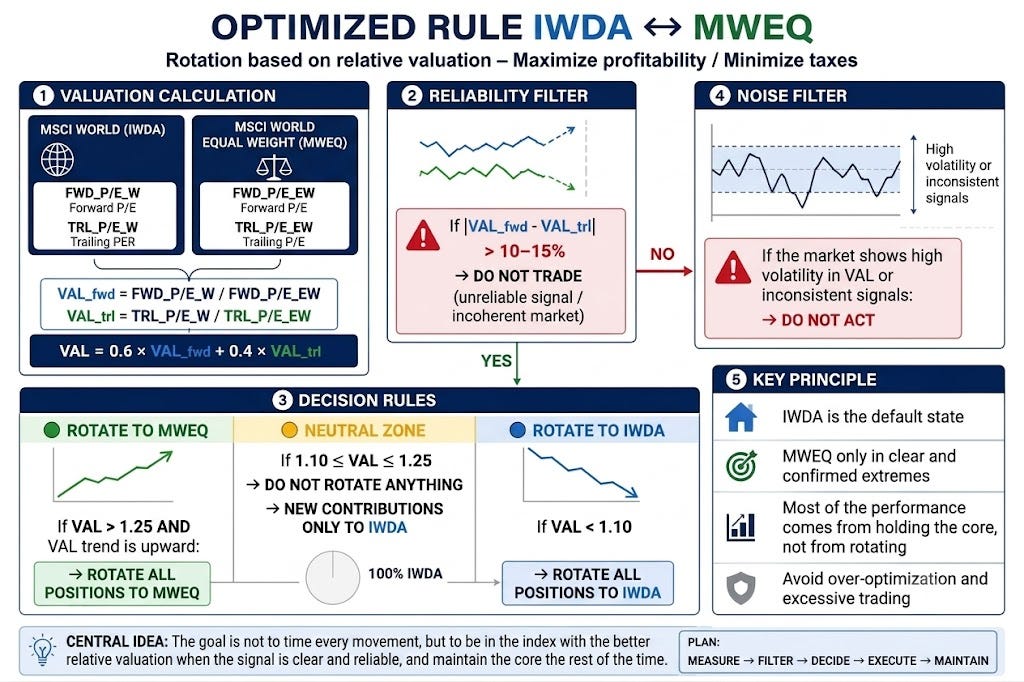
MSCI World is the system’s default state. Equal Weight only comes into play at clear, confirmed extremes. Most of the return comes from holding the core, not from constantly rotating between the two.
Why valuation alone isn’t enough: the momentum filter
We all know assets that have looked “cheap” for years and simply kept falling. Buying just because something looks cheap is the classic recipe for a value trap.
That’s why I add a second filter — momentum: I calculate the ratio Price MWEQ / Price IWDA. When that ratio starts rising on a sustained basis, it’s a signal that Equal Weight is starting to behave better in relative terms, and that the market is beginning to recognize that valuation gap.
P/E MSCI World vs MSCI World Equal Weight:
Forward P/E MSCI World vs MSCI World Equal Weight:
I don’t want to buy cheap. I want to buy cheap once it starts to stop falling.
On selling: patience is also part of the system
Full rotations generate taxes, and that’s a cost that’s very hard to recover. So, as long as I keep making periodic contributions, I simply direct new money toward whichever index offers the better relative valuation at that moment, without touching what’s already invested.
I reserve full rotations — selling one entire index to move into the other — for exceptional situations, when two conditions align at once: the valuation gap is extreme, and momentum confirms that market leadership is genuinely shifting. If only one condition is met, I do nothing. Waiting is also a decision.
Why MSCI World Equal Weight? A lesson from the dot-com bubble
Looking back at the 2000-2001 bubble, where extreme concentration also existed in the cap-weighted index, we can see clearly what tends to happen when the cycle turns or market leadership rotates.
When the large tech names — where all the concentration had built up — started to falter, the cap-weighted index dropped sharply. But the rest of the stocks, which had lagged badly during the preceding bull phase, held up considerably better: they didn’t follow the decline immediately, but with a notable time lag. Equal Weight ended up falling much less and took considerably longer to peak than the traditional index.
The takeaway for a rotation strategy is clear: when a decline begins in the mega caps that drags down cap-weighted indices, the equal-weighted index tends to temporarily decouple from that fall.
It’s true that MSCI World, by weighting in favor of the largest companies, tends to be more efficient under normal market conditions. But in bubble episodes, when concentration reaches extreme levels, it can make sense to spread the investment equally across all companies in the index until the divergence between MSCI World and MSCI World Equal Weight closes. That is precisely the underlying rationale for my rotation system between the two: extreme concentration is a phenomenon that tends to correct itself sooner or later, through a rebalancing process that can be slow, but that has historically arrived.
And it’s worth remembering that this dynamic isn’t exclusive to the United States. The case of MSCI Emerging Markets is, if anything, more extreme today: the index is heavily distorted by just three stocks — TSMC, Samsung, and SK Hynix — which account for a very significant share of the total, and which may be reflecting a bubble of their own in semiconductors.
What this system doesn’t try to do
It doesn’t try to predict the market, or beat MSCI World every single year, or find the perfect entry point. It can go through long stretches underperforming simply staying still, and that’s perfectly normal by design. Its goal is much more modest: to buy the same set of companies while trying to pay, at any given moment, a relatively more reasonable price for them. Nothing more, nothing less.
A process, not an opinion
Over time I’ve come to understand that the biggest advantage of having a system isn’t earning a few extra tenths of a percent in returns. It’s removing the emotional part of the decision. When the market falls, I don’t have to ask myself what to do. When tech stocks surge, I don’t either. I check the rule: if valuation and momentum point in the same direction, I act; if not, I wait.
Discipline, almost always, pays off more than brilliance.
Conclusion
I don’t believe MSCI World is better than Equal Weight, nor the reverse. They’re two different ways of looking at the same universe of companies, and the market goes through cycles that reward one first and then the other. My job isn’t to guess which cycle comes next. It’s to have an objective process that lets me adapt once that shift begins to unfold.
In the end, investing rarely comes down to finding the perfect asset. Most of the time, it simply comes down to making reasonable decisions consistently over many years.
This is not investment advice — everyone should study and design their own portfolio and strategies. If you enjoyed this article, subscribe to receive future posts.
Best to all.