

Muchos inversores ignoran por completo los bonos y ni siquiera se molestan en entender su funcionamiento. Pero los bonos son posiblemente el activo más importante del mercado, el que más lo mueve y, en buena medida, el que condiciona toda la economía.
Predecir el comportamiento de este activo es posiblemente una de las tareas más difíciles para un inversor, junto con el comportamiento de las divisas (de hecho, invertir en bonos implica, de forma indirecta, invertir en divisas: de nada sirve comprar bonos de un país al 4% de interés si la divisa de ese país cae un 8%). Predecir el comportamiento de los bonos implica predecir factores macroeconómicos, políticos del país del bono, así como factores geopolíticos e internacionales. En mi humilde opinión, casi nadie puede ver con certeza hacia dónde irán los tipos de interés de un país.
Sin embargo, una cartera diversificada debe tener bonos que te protejan en ciertos escenarios y ciclos económicos, por ejemplo en una etapa prolongada de recesión o para amortiguar un crash por un cisne negro.
En mi cartera, considerando la situación actual donde la renta variable podría estar bastante sobrecalentada, tengo una posición considerable en activos fuera de la renta variable (oro, bonos, materias primas, liquidez...). En concreto, mi posición actual en bonos asciende a un sustancial 30% de la cartera.
Puesto que considero tremendamente difícil adivinar hacia dónde irán los tipos de interés y las divisas de cada país, toda mi posición en bonos la tengo a través de un ETF que sigue el Bloomberg Aggregate Bond Index. El Bloomberg Aggregate Bond Index está compuesto principalmente por bonos gubernamentales, corporativos y respaldados por hipotecas de alta calidad crediticia, los cuales se diversifican de forma equilibrada a través de diferentes sectores económicos, regiones geográficas y plazos de vencimiento (duración). Esta variedad de plazos y emisores permite capturar el comportamiento general de la renta fija segura, reduciendo el riesgo y ofreciendo una imagen clara de cómo se mueve el mercado de deuda a nivel global o regional.
iShares Core Global Aggregate Bond UCITS ETF
El ETF que utilizo para invertir en bonos es el ETF AGAC de BlackRock: iShares Core Global Aggregate Bond UCITS ETF:
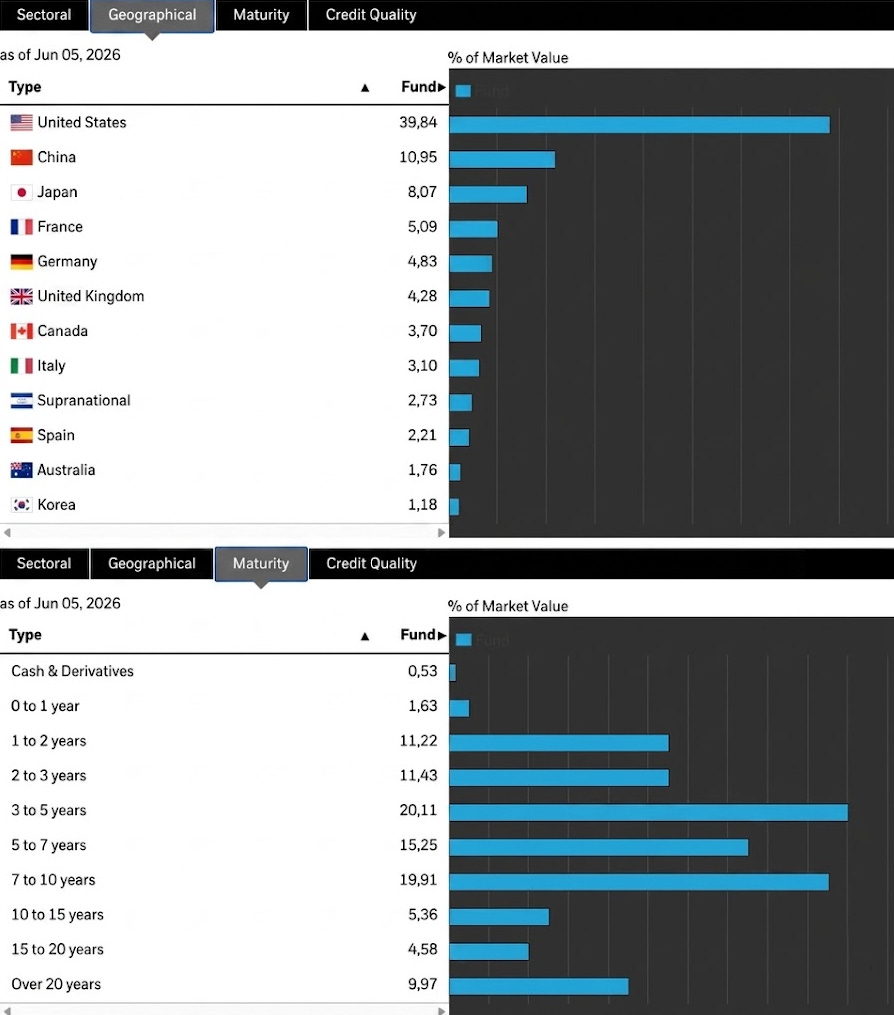
El ETF está diversificado en bonos gubernamentales y corporativos de distintos países y duraciones, predominando los bonos estadounidenses, y teniendo una duración media de 6–7 años.
Y el “Lambo” para cuándo
Efectivamente, los bonos no te van a hacer trillonario. Los bonos son un tipo de activo que nos ofrece estabilidad, seguridad y menor volatilidad en la cartera, obviamente con una rentabilidad mucho más ajustada.
El problema es que muchas veces, cuando compramos un ETF de este tipo, es muy difícil calcular qué rentabilidad podemos esperar a medio plazo, al menos para un inversor retail como muchos de nosotros. No porque sea difícil estimar la rentabilidad de un bono. Todo lo contrario: cuando compras un bono, sabes de antemano, siempre y cuando no se produzca un impago, la rentabilidad que puedes obtener (a diferencia de la bolsa, donde necesitas hacer una estimación). Es difícil porque la cantidad de activos (bonos) que componen el ETF es altísima.
En la propia web de BlackRock podemos descargar un documento CSV con todos los holdings que componen el ETF AGAC y podemos observar que son en torno a 20.000 bonos diferentes.
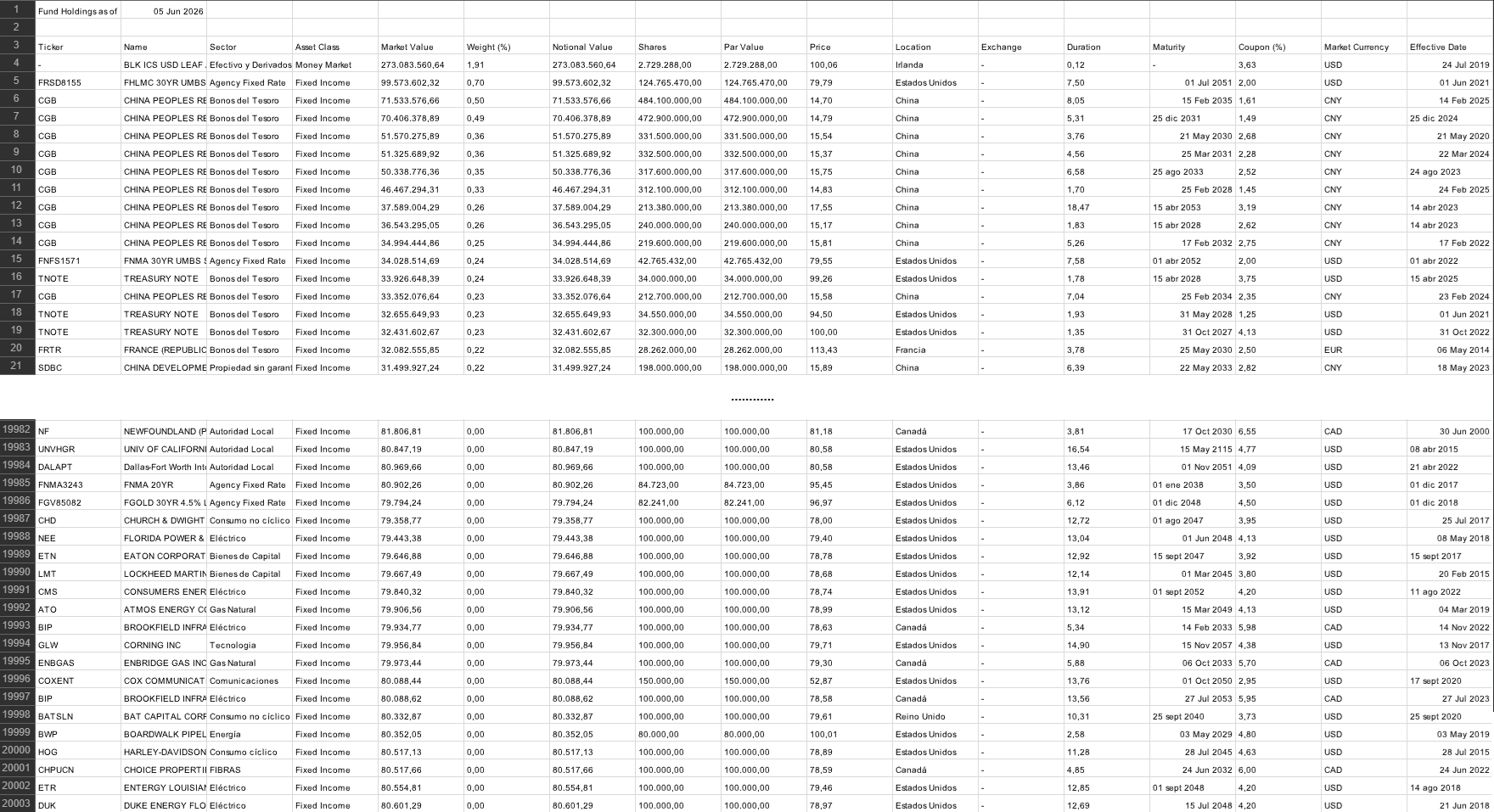
Si quisiéramos calcular qué rentabilidad exacta nos ofrecen los bonos que componen el ETF necesitaríamos obtener la rentabilidad exacta de cada uno de ellos hoy mismo (al precio de mercado actual de ese bono, no nos basta con saber su cupón), para luego calcular una media de todas las rentabilidades (una media ponderada según el peso de cada bono en el total del ETF).
Quizás grandes empresas como BlackRock pueden realizar este cálculo en tiempo real sin problemas, pero para inversores retail como la mayoría de nosotros, esto es una tarea titánica.
Cálculo de la rentabilidad aproximada
Puesto que calcular la rentabilidad exacta, como comentábamos en el apartado anterior, se escapa a nuestras capacidades, necesitamos idear un plan para hacer un cálculo aproximado.
Como vimos en las capturas un poco más arriba, BlackRock nos ofrece en su web el porcentaje de bonos de cada país, así como el porcentaje de bonos por duración.
Aquí obviamente hay bonos gubernamentales y corporativos, y las rentabilidades de cada uno son diferentes.
En nuestra aproximación lo que haremos será asumir que son bonos gubernamentales. Y lo que haremos será cruzar la tabla de peso por país con la tabla de peso por duración, para construir una matriz de pesos de cada par país-duración. Una vez construida dicha tabla, necesitaremos obtener la rentabilidad actual de los bonos para cada país y cada duración. Podríamos obtenerla, por ejemplo, en TradingView (si queremos ver la rentabilidad de los bonos de 30 años estadounidenses, buscaríamos el ticker US30Y. Para el de China a 20 años, CN20Y. Y así sucesivamente).
Puesto que tenemos 96 pares país-duración (habiendo tenido en cuenta solo los países que más pesan en el ETF), es un trabajo obtener manualmente cada rentabilidad (que además cambia con el precio del bono en el mercado). Así que hemos pedido a Gemini, la inteligencia de Google, que nos complete la tabla con las rentabilidades de cada país-duración.
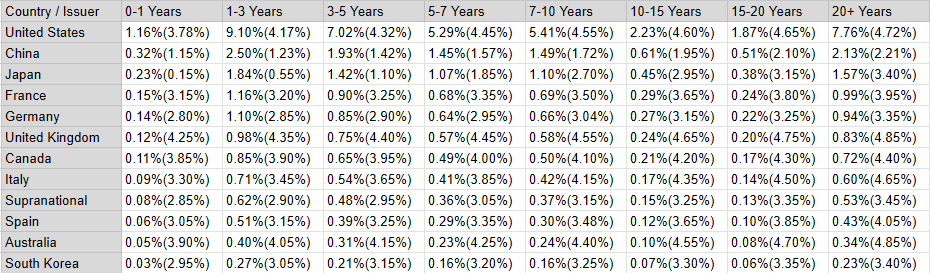
En la captura anterior podemos observar que cada celda de la tabla corresponde al peso en el ETF de ese par país-duración y, entre paréntesis, la rentabilidad actual de esos bonos. Por ejemplo, el 1,16% del ETF corresponde a bonos estadounidenses de 0 a 1 años de duración, cuya rentabilidad ronda el 3,78%.
Con esta tabla, solo necesitamos calcular la media ponderada (en base a los pesos de cada par bono-duración en el ETF) de todas las rentabilidades.
Hemos pedido a Gemini que realice este cálculo y, según este, la rentabilidad media que nos ofrecen toda esta lista de bonos es aproximadamente del 3,61%.
Debemos tener en cuenta que hemos asumido que todos los bonos son gubernamentales y que, para cada par país-duración, hemos usado la rentabilidad del bono de ese país para esa duración. Los bonos corporativos ofrecen un extra de rentabilidad (porque también tienen un extra de riesgo frente a los gubernamentales). Así que posiblemente la rentabilidad real del ETF gire en torno al 4%.
Yield to Worst
A pesar de que hemos realizado este ejercicio para calcular una rentabilidad aproximada de nuestro ETF y para entender mejor en qué estamos invirtiendo, normalmente las empresas que emiten dicho ETF ya nos ofrecen algunas métricas que nos ahorran tener que hacer cálculos manualmente.
Si vamos al fact sheet del ETF AGAC, actualizado a abril de 2026, podemos ver algunas métricas que coinciden con nuestros cálculos:
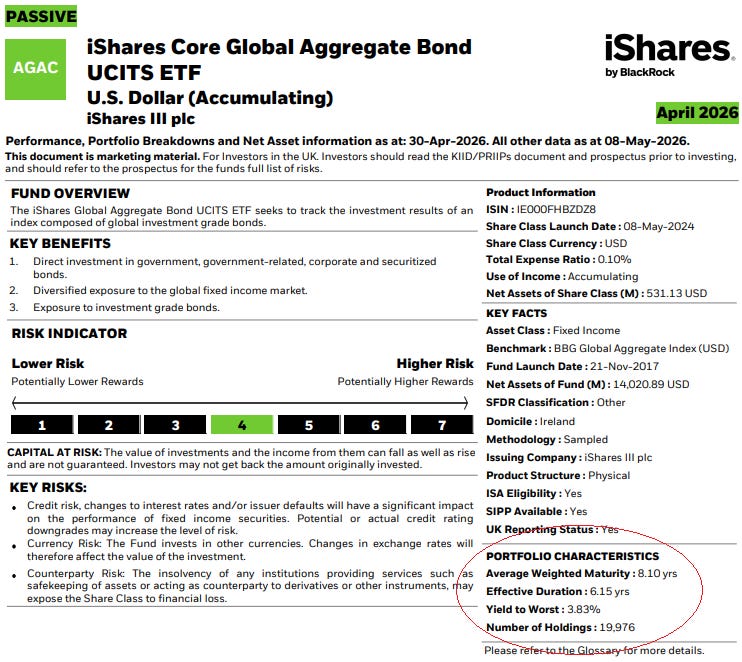
Average Weighted Maturity: 8.10 yrs
Effective Duration: 6.15 yrs
Yield to Worst: 3.83%
Number of Holdings: 19976
El Yield to Worst (YTW) (que se podría traducir como “rentabilidad en el peor de los escenarios”) es una métrica clave en el mundo de la renta fija. Básicamente indica la mínima rentabilidad anualizada estimada que puedes esperar recibir de un bono o de una cartera de bonos (como este ETF), asumiendo que el emisor no quiebre.
Conclusión
Los bonos son un activo relativamente aburrido, y deben serlo, pero espero que este artículo no os haya resultado un ladrillo y que os haya ayudado a echar un poco de luz a un activo que muchos inversores desconocen o ignoran, pero que, en mi opinión, es importante no perder de vista y tener en nuestras carteras.
En cualquier caso, como siempre, esto no es un consejo de inversión, y cada uno debe estudiar y diseñar su propia cartera y decidir qué activos son apropiados para su perfil.
Si os ha gustado este artículo, suscribiros para recibir futuros posts en vuestro email. Saludos!