

Se dice que a río revuelto, ganancia de pescadores. Y si te has dado una vuelta por redes sociales o por las noticias sobre economía e inversión, ya te habrás dado cuenta de que todo el ecosistema de los pagos está bastante revuelto:
Competencia feroz entre actores tradicionales y nuevos entrantes.
Disrupción tecnológica constante.
Criptomonedas y stablecoins empujando desde fuera del sistema.
Bancos centrales liándola parda con sus propias iniciativas digitales.
Regulación y control fiscal apretando cada vez más.
Pagos A2A (account to account), ofrecidos por algunos adquirentes para pagar directamente con el banco, de una cuenta a otra, saltándose gran parte del ecosistema tradicional, dejando fuera, por ejemplo, a Visa y Mastercard.
Pagos Closed-Loop de saldo a saldo dentro de la misma aplicación.
Inteligencia artificial rediseñando procesos que llevaban décadas sin tocarse.
Y hasta el “tap to pay“, que convierte el móvil en un datáfono y deja fuera aparatos que antes eran imprescindibles.
Es un mundo que yo diría que es sencillo en el fondo, porque todo tiene su lógica cuando lo entiendes. Pero en el que ahora mismo está todo un poco liado. Algo que en principio parece simple (”doy la orden para que el dinero de la fuente X, normalmente una cuenta bancaria, aparezca en el destino Y, también una cuenta bancaria habitualmente”) se ha convertido, con décadas de desarrollo por parte de distintos actores, en un Frankenstein con muchas capas de funcionalidad encima.
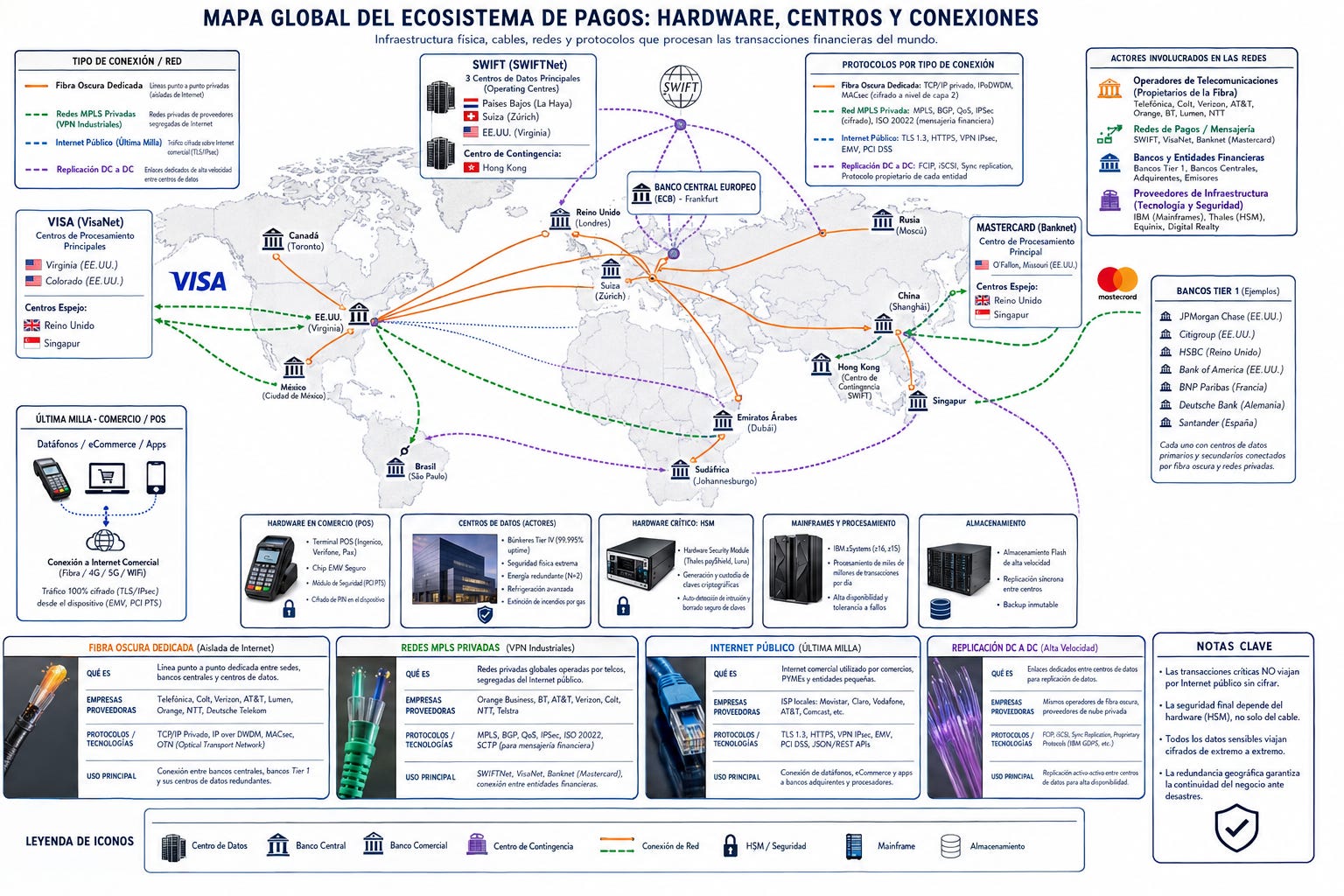
Cuando ves todo el ecosistema junto, la sensación que da es que podría simplificarse enormemente. Y ese es, en mi opinión, el mayor peligro estructural para muchas de las empresas del sector. Con las redes y las tecnologías que había hace dos décadas, todo tenía sentido. Pero con la tecnología que existe hoy, servidores tremendamente potentes y un mundo 100% interconectado con redes veloces, mucha de la funcionalidad parece redundante — capas que podrían eliminarse o colapsarse, dejando fuera a actores que hoy cobran por estar en medio.
En próximos posts voy a analizar varias empresas de este sector, y este artículo es una introducción necesaria para entender el ecosistema de los pagos de forma general. En las próximas secciones intentaré dar una visión global del mismo.
⚠️ Aviso a navegantes: se viene ladrillazo ⚠️
Las próximas secciones podrían ser un poco espesas, pero creedme que merece la pena tener un poco de paciencia, porque una vez tienes el contexto y entiendes todo el ecosistema de pagos, es mucho más fácil entender el porqué de cada empresa, qué hace cada una, cómo de importante es y por qué tiene moat o no, o por qué peligra su existencia.
Movimientos B2B: Banco-Banco
La base de todo este ecosistema es la transferencia de capital entre bancos, desde una cuenta bancaria hasta otra. El resto de capas (toda la red para pagos con tarjeta de Visa o Mastercard, los adquirentes como Adyen o Fiserv, los pagos A2A, etc…) al final podrían considerarse complementos para facilitar y hacer más cómodas y seguras estas transferencias entre cuentas bancarias.
“Transferencia entre cuentas bancarias” suena a algo sencillo, y en realidad debajo hay una infraestructura brutal que poca gente conoce.
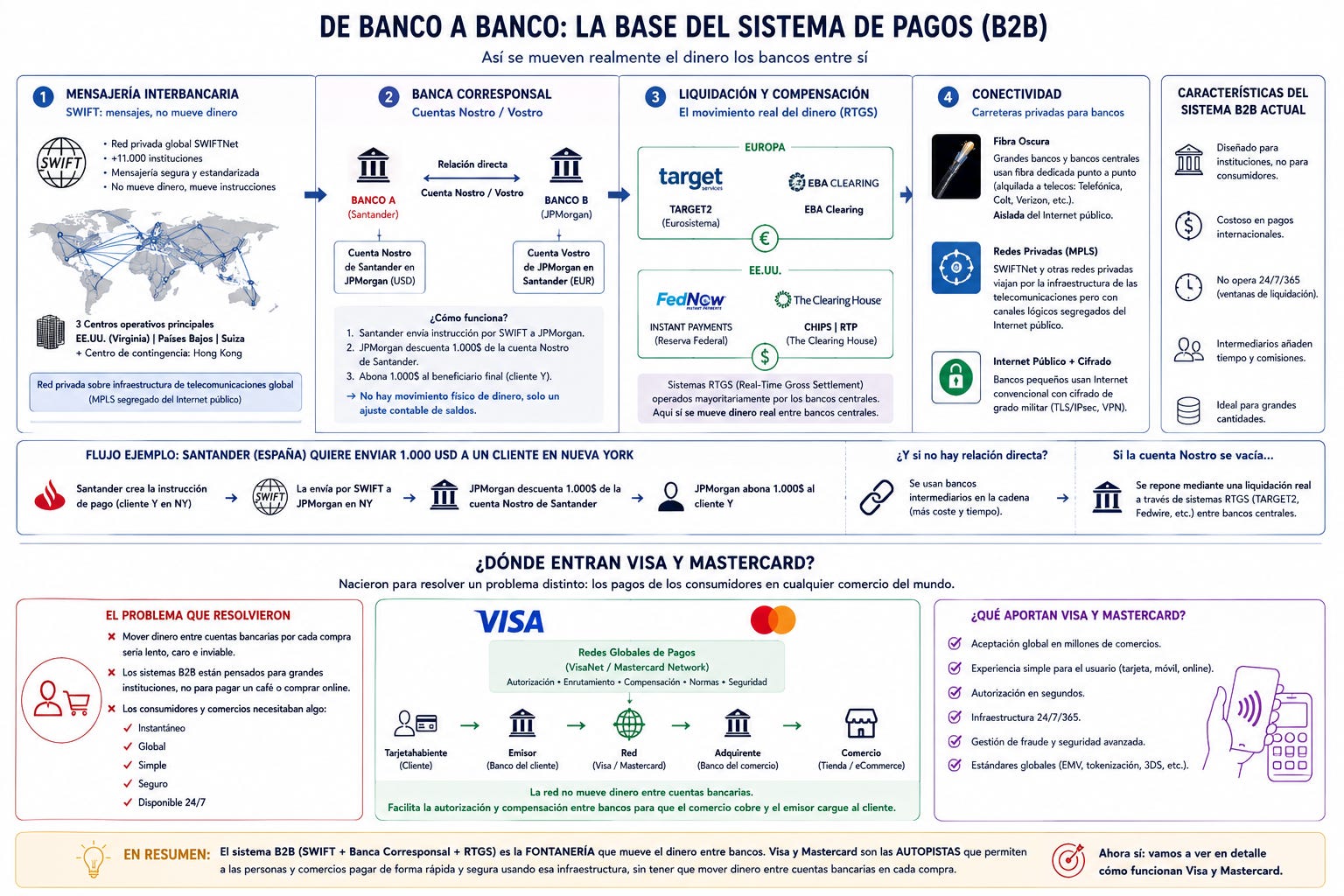
Lo primero que hay que entender es que los bancos no se comunican por el mismo internet que usas para ver Netflix. Los grandes bancos (los llamados Tier 1: JPMorgan, Citigroup, BNP Paribas, Bank Of America, Santander...) y los bancos centrales usan lo que se conoce como fibra oscura: filamentos de fibra óptica alquilados a largo plazo a operadoras de telecomunicaciones que están dedicados exclusivamente a ese tráfico. Nadie más pasa por ahí. Es literalmente un tubo de luz privado del punto A al punto B. De esta manera consiguen aislar la red y evitar en gran medida problemas de ciberseguridad.
Para conexiones internacionales entre las instituciones financieras más importantes, la historia es parecida pero a mayor escala. SWIFT (la cooperativa que conecta a más de 11000 instituciones financieras de todo el mundo) no se ha dedicado a tirar sus propios cables cruzando el Atlántico. Sin embargo sí opera su propia red privada global (SWIFTNet, una VPN de escala gigante basada en tecnología MPLS), y para ello utiliza la infraestructura física de las grandes telecos, pero de una forma completamente segregada del internet público: por así decirlo, utiliza el mismo canal físico (los mismos “cables gordos” de internet) pero tiene canales lógicos propios, “paralelos” a internet.
Además, algunas zonas pueden tener sus propias “carreteras” internas. Por ejemplo en Europa existe SEPA (Single Euro Payments Area) y SEPA Instant (la versión Fórmula 1 de SEPA). Para transferencias dentro de Europa, no llega a usarse SWIFT. En España específicamente existe Iberpay (SNCE).
Los bancos más pequeños, los que no pueden permitirse usar este tipo de infraestructura, sí usan el internet convencional, pero con cifrado de grado militar.
La banca corresponsal
Aquí llega un concepto importante, que es el que realmente explica cómo funciona el sistema: la banca corresponsal. Y algo importante para entender el ecosistema: SWIFT no mueve dinero. Mueve mensajes. Es básicamente un sistema de mensajería ultrasegura entre bancos. El dinero en sí se mueve a través de otro conjunto de actores: las cámaras de compensación.
Mensajería interbancaria.
SWIFT.
Liquidación y compensación (el movimiento real del dinero).
En Europa: TARGET2 (operado por el Eurosistema, el banco central) y EBA Clearing.
En EE.UU: FedNow (el sistema de la Reserva Federal, relativamente reciente) y The Clearing House (opera CHIPS y RTP).
Estos sistemas de liquidación son lo que se conoce como RTGS (Real-Time Gross Settlement), y son operados mayoritariamente por los propios bancos centrales. Son la fontanería real del sistema financiero.
Los grandes bancos internacionales tienen cuentas abiertas unos en otros. El Santander tiene una cuenta con dinero real depositado en JPMorgan (y viceversa). Cuando el Santander quiere mandar dólares a JPMorgan en Nueva York, SWIFT es el canal por el que viaja la instrucción segura: “Oye, JPMorgan, soy Santander. Quítame 1000$ de mi cuenta contigo y dáselos al cliente con cuenta Y”. Cuando el Santander manda esa instrucción por SWIFT, JPMorgan simplemente hace un apunte contable: descuenta el importe de la cuenta que el Santander tiene con ellos y lo abona al destinatario final. No hay movimiento físico de dinero en ese momento, solo un ajuste de saldos.
Y si el banco que quiere enviar no tiene una relación directa con el banco destino, utiliza uno o varios bancos intermediarios que sí la tengan. Eso es lo que hace que algunas transferencias internacionales sean lentas (1-3 días hábiles) y caras: hay que pagar a cada intermediario que toca la cadena.
Ahora bien, si el Santander hace muchas transferencias hacia EE.UU y pocas en sentido contrario, esa cuenta que tiene en JPMorgan se va vaciando. En algún momento hay que reponerla con dinero real, y eso se hace mediante liquidaciones reales entre bancos a través de los sistemas de los bancos centrales: los sistemas RTGS ya comentados, como TARGET2 en Europa o Fedwire en EE.UU. Ahí sí se mueve dinero de banco central a banco central, que es el dinero “real” en el fondo del sistema.
Las limitaciones del sistema Banco-Banco
El sistema que acabamos de describir funciona. Y lleva décadas funcionando. Pero tiene fricciones evidentes: es caro en pagos internacionales, no opera 24/7, y en cuanto sales de tu zona geográfica aparecen intermediarios, tiempos de espera y comisiones que se acumulan. Además, todo este ecosistema está pensado para mover cantidades grandes entre instituciones, no para que tú pagues un café o compres algo por internet.
Y ahí está precisamente el origen de la siguiente capa del ecosistema. Visa y Mastercard no nacieron para competir con SWIFT ni con las cámaras de compensación. Nacieron para resolver un problema completamente distinto: cómo hacer que un particular pueda pagar en cualquier comercio del mundo de forma cómoda, rápida y segura, sin tener que mover dinero entre cuentas bancarias cada vez que compra algo.
Pagos C2B: Del Consumidor al Negocio
En un pago convencional con tarjeta, el flujo lógico es:
Comercio → Gateway → Adquirente → Redes de Pago (Visa/MC) → Banco Emisor
Y el dinero hace exactamente el camino inverso durante la fase de liquidación, por las noches, a través de las cámaras de compensación que ya vimos antes.
Las redes de pago como Visa o Mastercard operan sobre infraestructura privada — básicamente una VPN enorme con contratos millonarios con las operadoras de telecomunicaciones, completamente segregada del internet público. Un retardo de unos pocos milisegundos más allá de lo acordado deriva en indemnizaciones importantes. Lo que ofrecen, en esencia, es velocidad en la autorización del pago y la infraestructura para que después todo cuadre.
La magia del mensaje en 200 milisegundos
Redes como VisaNet o Banknet son capaces de procesar miles de transacciones por segundo con una latencia casi nula. Cuando el cliente pasa la tarjeta por el datáfono, ocurren dos fases que operan a velocidades y en mundos totalmente distintos:
Fase 1: Autorización (tiempo real, menos de 1 segundo)
Un mensaje viaja siguiendo el flujo de software mencionado desde el comercio hasta el banco emisor. El banco dice “este cliente tiene saldo o crédito suficiente, aprobado“. Ese OK bloquea el dinero en la cuenta del cliente y le asegura al adquirente — y por tanto al comercio — que el pago va a producirse. Nadie ha movido un solo céntimo todavía, pero el café ya es tuyo.
Fase 2: Compensación y Liquidación (Clearing & Settlement — diferido, por la noche)
Aquí es donde el “Mundo Tarjeta” se conecta con el “Mundo Transferencia”.
A lo largo del día se van acumulando autorizaciones en cada pago. Al final del día, cuando todos los comercios cierran sus terminales, los adquirentes vuelven a hablar con Visa, Mastercard o la red de pagos correspondiente. Empaquetan millones de transacciones y las mandan para hacer el “neteo”: la compensación entre todos los bancos. Y a través de los sistemas RTGS de los bancos centrales que ya comentamos (TARGET2, FedWire), se realiza el movimiento real del dinero.
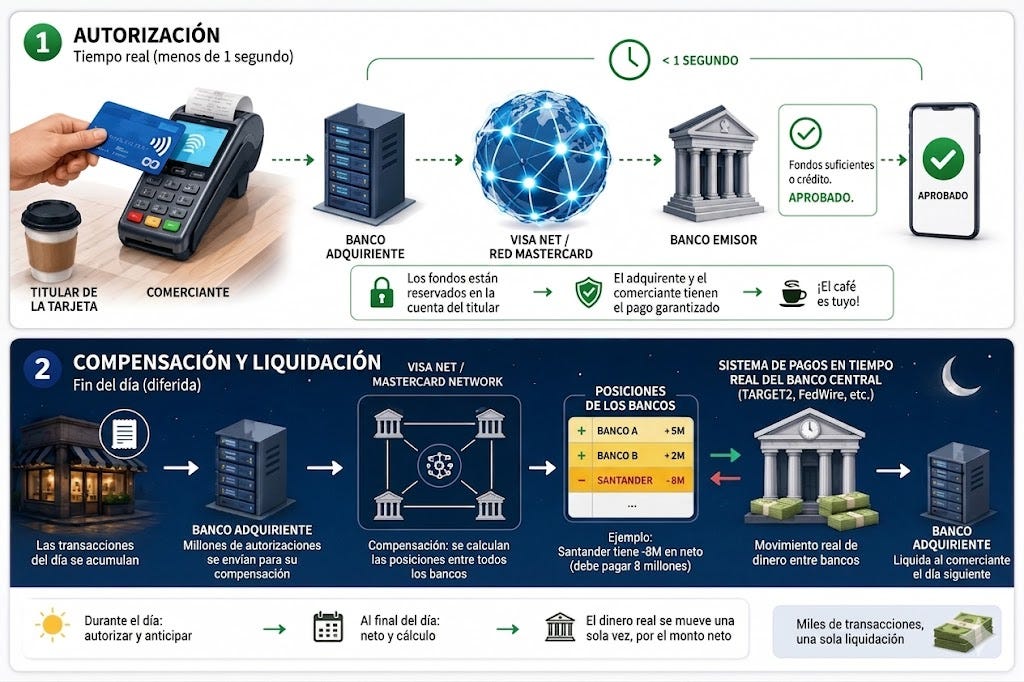
Es decir: primero se autorizan y “anticipan” todos los pagos a lo largo del día, y cada cierto tiempo se hace recuento de todo el dinero que realmente tiene que moverse. Las redes de pago hacen la magia de esa compensación.
“A ver, Santander: tus clientes han gastado 10M fuera de tu banco. Pero a los comercios que tienen cuenta contigo les han comprado 2M desde tarjetas de otros bancos. En el neto global del día, estás en negativo por 8 millones. Tienes que pagarlos.”
Y el neteo consiste precisamente en eso: el Santander no hace miles de transferencias para pagar los 10M y recibir los 2M. Simplemente salda su posición neta diaria — los 8 millones — a través del sistema RTGS con el que opera su banco central.
¿Y para qué sirven los adquirentes?
Tras leer las secciones anteriores podría parecer que los adquirentes son solo un intermediario entre el comercio y la red de pagos que chupa del bote. Y efectivamente son un intermediario chupando del bote, pero en las siguientes líneas veremos que realmente se ganan el pan.
Uno podría pensar: si la red de pagos ya hace todo esto, ¿por qué el datáfono no le da los datos del cliente directamente a Visa o a Mastercard para que ellos autoricen y más tarde liquiden el pago? ¿Por qué Apple, Spotify o Uber pagan millones a Adyen en lugar de conectarse directamente a Visa?
La razón principal es que el mundo es caótico. Hay millones de comercios, cada uno con sus particularidades — su zona geográfica, su tipo de negocio, su cliente.
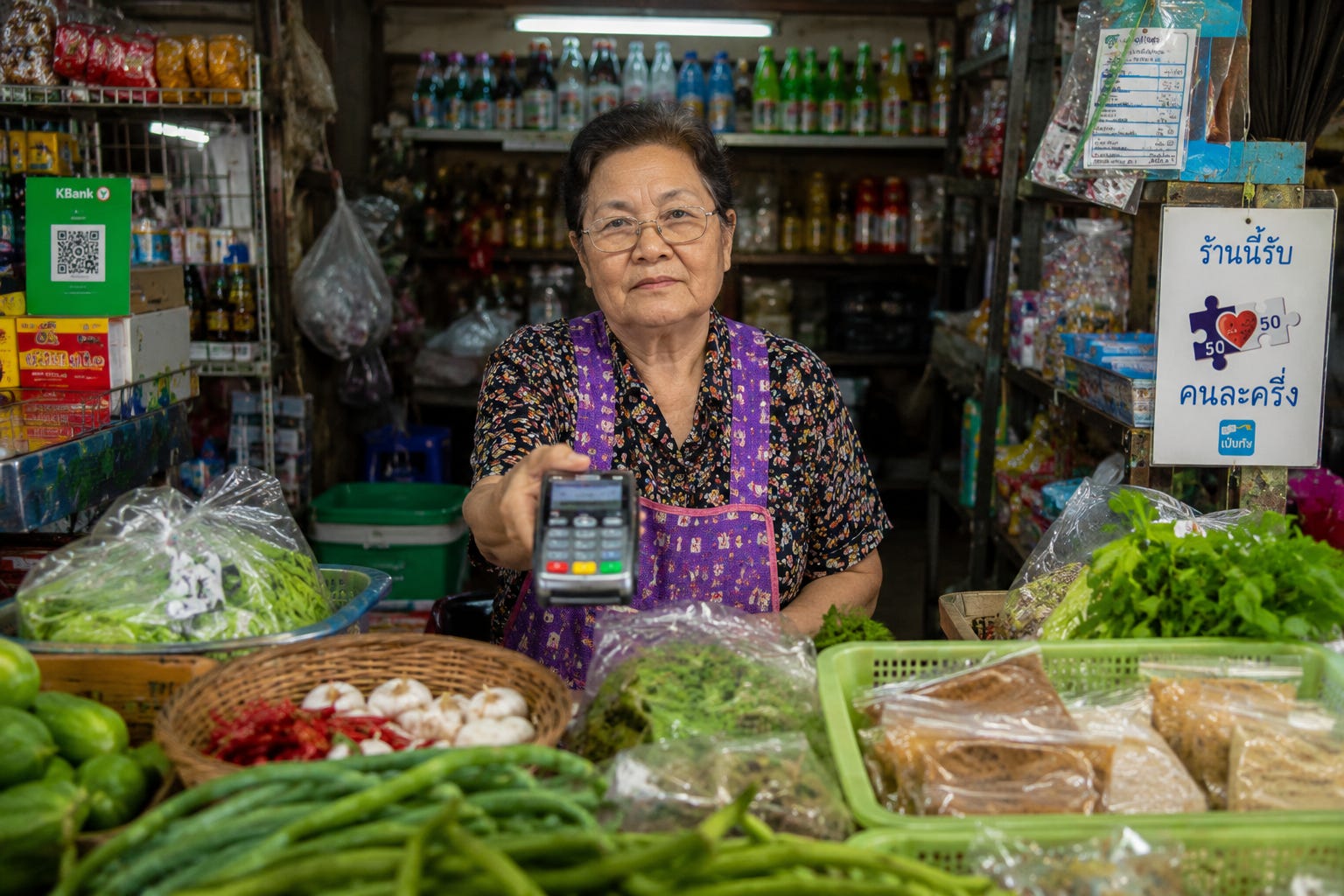
Conectar ese caos con las ultra-estrictas redes de Visa y Mastercard es una pesadilla de ingeniería, regulación, riesgo de fraude y gestión de tesorería. Es como intentar enchufar una tostadora doméstica directamente a una torre de alta tensión. Necesitas un transformador que adapte la potencia, gestione los picos de tensión, te asegure que no salga ardiendo la casa y, además, te agrupe la factura a fin de mes. Ese transformador es el adquirente.
Traductor
El adquirente hace de traductor: toma el formato web de Uber o el código del datáfono de la esquina, lo limpia, lo cifra y se lo entrega a la red de pagos masticado y perfecto. Si la red de pagos tiene un problema en un momento dado, el adquirente retiene la petición y la reintenta, salvando la venta del comercio.
Smart Routing
Si te conectaras directamente a Visa, estarías atrapado en su camino único. Un adquirente global como Adyen hace Smart Routing: cuando metes tu tarjeta en una web internacional, el adquirente analiza en milisegundos de qué banco es la tarjeta, de qué país, qué red es más barata en ese momento. Si ve que procesar el pago por Visa internacional va a costar un 2% y tiene una probabilidad de rechazo del 15% por sospecha de fraude, puede decidir enrutar ese pago a través de una red local o un acuerdo directo con el banco emisor. Esto maximiza la tasa de conversión — que el pago no sea denegado por error —, que es lo que realmente le importa a un comercio online.
Escudo Anti-Fraude
El adquirente asume el riesgo de crédito y fraude del comercio. Por eso, para ser adquirente necesitas una licencia financiera. Adyen analiza la salud financiera de Spotify o de la aerolínea de turno antes de contratarlos. Si la aerolínea quiebra y miles de clientes reclaman sus vuelos, Adyen tiene que devolver ese dinero de su propio bolsillo. Visa no quiere asumir el riesgo de lidiar con millones de comercios; prefiere exigirle responsabilidades a un puñado de adquirentes regulados y que ellos se las arreglen con cada cliente y cada comercio.
Tesorería
Imagina que un comercio vende mil cafés al día a 2€ cada uno. Si Visa liquidara directamente con el comercio, tendría que hacer mil micro-transferencias diarias — ineficiente y carísimo. El adquirente actúa como embudo: recibe de los bancos emisores un único bloque de fondos netos correspondiente a millones de transacciones, descuenta su comisión (más la de Visa y la del banco emisor), y le ingresa al comercio un único pago limpio al día o a la semana. El comercio no concilia nada; solo ve un ingreso diario en su cuenta.
Pagos U2U: Usuario-Usuario (P2P Peer-to-Peer)
El tercer gran bloque del ecosistema es el más cercano al usuario de a pie: mandarte dinero a un amigo para pagar la cena, dividir el alquiler, o saldar una deuda. En teoría es el caso de uso más sencillo de todos — dos personas, dos cuentas, una cantidad. En la práctica, durante décadas fue también el más incómodo, porque exigía conocer el IBAN del otro, esperar un día hábil y rezar para no equivocarse de número.
Lo que ha cambiado en los últimos años es que estos pagos ya no necesitan pasar por las redes de tarjetas. Usan directamente otros raíles bancarios que ya describimos — SEPA Instant, sistemas RTGS, APIs de Open Banking — pero con una capa de software encima que hace que el proceso sea tan rápido y sencillo como mandar un mensaje de WhatsApp.
Los ejemplos más relevantes a nivel global:
Bizum (España): Corre sobre Iberpay y SEPA Instant. En lugar de pedir el IBAN, usas el número de móvil. El dinero llega en segundos.
Zelle (EE.UU.): Consorcio creado por los grandes bancos americanos para competir con las apps de terceros. Opera directamente entre cuentas bancarias, sin saldo intermediario.
Venmo / Cash App (EE.UU.): Modelo diferente — el dinero queda en un saldo dentro de la propia app (lo que se llama “closed-loop” o bucle cerrado) hasta que el usuario decide transferirlo a su banco. Más flexible para el usuario, pero el dinero no está en tu cuenta bancaria real hasta que lo sacas.
Pix (Brasil): Creado directamente por el Banco Central brasileño. Uno de los casos de éxito más llamativos a nivel global — en pocos años se convirtió en el método de pago dominante en Brasil, desbancando tanto a las transferencias tradicionales como al efectivo.
UPI (India): La Unified Payments Interface india es probablemente el ecosistema P2P más grande del mundo por volumen de transacciones. Un caso de libro de cómo la intervención regulatoria puede acelerar la adopción masiva de pagos digitales.
Lo interesante de esta capa, desde el punto de vista inversor, es que es donde más claramente se ve la amenaza para el ecosistema tradicional. Estos sistemas no pagan tasas de intercambio a Visa ni a Mastercard. No necesitan adquirentes. Van directos de cuenta a cuenta. Y en los países donde han despegado de verdad — Brasil, India, China con WeChat Pay y Alipay — la penetración de las redes de tarjetas tradicionales ha quedado estructuralmente limitada.
Conclusión: El mapa antes del territorio
Si has llegado hasta aquí, enhorabuena — y gracias por la paciencia. Era un ladrillazo, lo sé. Pero era un ladrillazo necesario.
El ecosistema de pagos es de esos sectores donde es muy fácil leer titulares (”Visa gana X millones”, “PayPal pierde cuota de mercado”, “las stablecoins van a cargarse a los bancos”) sin tener claro exactamente qué está pasando por debajo. Y sin ese contexto, es muy difícil saber si el titular importa, si el riesgo es real, o si es simplemente ruido.
Lo que hemos visto en este artículo es que el ecosistema tiene tres grandes capas bien diferenciadas. La capa B2B, que es la fontanería real del sistema financiero — SWIFT, corresponsales, cámaras de compensación — y que lleva décadas funcionando pero arrastra fricciones evidentes en los pagos internacionales. La capa C2B, donde Visa y Mastercard construyeron su imperio precisamente para resolver lo que el sistema B2B no podía hacer: que un consumidor pague en cualquier comercio del mundo de forma cómoda y segura. Y la capa P2P, que es la más nueva y la que más claramente amenaza a las capas anteriores, porque va directa de cuenta a cuenta sin necesitar ni redes de tarjetas ni adquirentes.
Y encima de todo esto: disrupción por todos los flancos. Pagos A2A, stablecoins, Open Banking, iniciativas de bancos centrales. Todos atacando alguna de estas capas. Todos con argumentos reales. Ninguno, de momento, con una victoria decisiva.
Y en estos momentos de incertidumbre, estos momentos en que las empresas de un sector están golpeadas, es cuando merece la pena entender y estudiar dicho sector. Porque como decíamos al principio, a río revuelto, ganancia de pescadores.
Eso es precisamente lo que viene en los próximos posts. Tengo en el radar empresas como Visa, Mastercard, Adyen, Fiserv o PayPal — cada una operando en una capa distinta del ecosistema, con modelos de negocio distintos, y con amenazas distintas encima de la mesa. Ahora que tenemos el mapa general, podemos analizar cada empresa con mucho más contexto y más sentido.
Nos vemos en próximos posts. Suscribíos para recibirlos directamente en vuestro email.
Saludos!